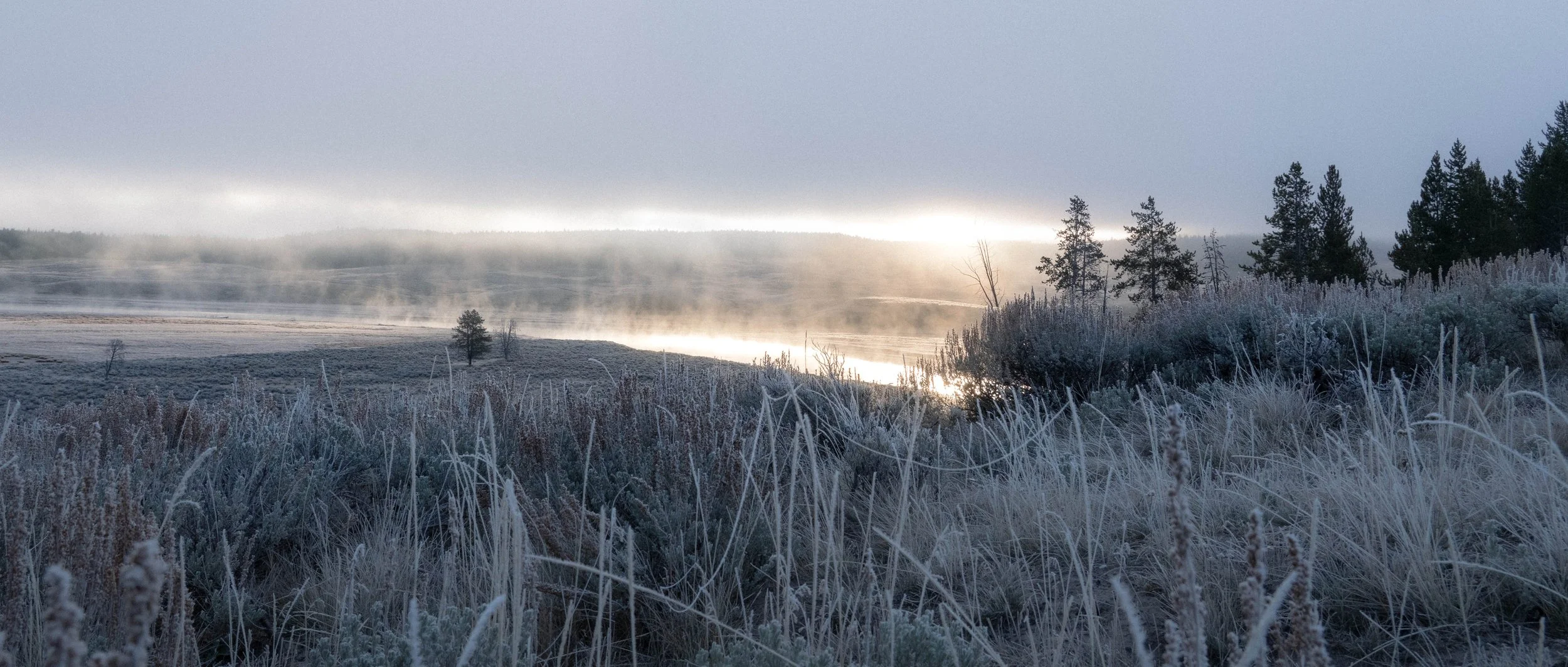
Yellowstone - The Land in Motion
You cannot take this place in. Most who come drive through it once, and the valley becomes a view between two points. But Yellowstone does not reveal itself to passing eyes. It is too large, too slow, too full. To begin to feel it, you have to leave the road, walk the land, and accept that you will never hold all of it at once.
That, in the end, is the gift. The land is too vast to grasp — and in failing to grasp it, you feel your own size honestly: part of something far larger than yourself.
The Breath of the Earth
Beneath Yellowstone, the earth has never settled. Heat rises through thin ground; the land steams, hisses and shifts. Here geology is not history but a process still underway — the planet showing its raw, unfinished interior.
It was a cold morning at Grand Prismatic Spring. The hot water met the freezing air and rose into a fog so dense it swallowed the boardwalk. People walked into it and disappeared — figures stepping through a portal into a primordial world, into the unfinished beginning of the earth itself.
Open Ground
The Lamar Valley is a single, immense plain — a painting on a scale the eye cannot frame. Highway 212 runs through it, and most travellers follow that line and call it seen. But the stories are not on the road. They are out in the grass, at the far edges, in the small movements you only find by walking. The valley asks for time and effort it rarely receives.
To the east, the Beartooth Mountains rise as its crown — among the most beautiful high country I know. And after all of it comes the same lesson the place keeps teaching: you will not grasp the whole of it. You were never meant to.
THOSE WHO BELONG
These animals are not placed into the landscape; they emerge from it.
The grizzly is the unchallenged king of this country — king by presence, not by force. In some fifty encounters, not one turned violent. The rule is simple: show that you are neither prey nor threat, and you each go your way. There is a deep calm in standing near an animal that has nothing to prove.
I have seen wolves only once — late evening, a kilometre off across the Lamar, a pack feeding on an elk they had brought down. Even at that distance, even that rarely, their presence is constant: the shadows of the land. They were absent for seventy years. Their return sent changes through the whole system that ecologists are still tracing today. A valley is a different place when the wolves are in it, whether you see them or not.
The coyote appears and is gone — at the edge of a meadow, then nowhere. Everywhere in this land, and never quite there.
And then the ones the land is built around — elk, bison, moose, and the deer at the treeline. They are not the backdrop to the predators; they are the reason the rest exists.
SEASON OF CHANGE
I have come back across seven years — in autumn light, in spring green, and in the first snows of winter. The season I return to most is the turning one, when the crowds thin, the valley quiets, and the land seems to draw breath before the cold.
And there is one more thing I carry from here. This was the first stretch of land anywhere that people chose to set aside and protect — not to use, but simply to let it be. Much of the sensibility I bring to wilder, less-guarded places was, in some way, born in this one. To stand in Yellowstone is to stand at the beginning of the idea that such places are worth keeping.
To feel that is, for me, the first step toward protecting what comes after.